
Vastu Direction Chart: Understand All 16 Directions Before You Plan a Home
⏱️ 12 Min Read
🏡 Vastu Home Planning Guide
At 10:30 on a hot afternoon, a homeowner can make an expensive mistake. They may reject a good flat because the entrance faces south. They may pay for a remedy without checking north.
That is why a Vastu direction chart needs more than a colourful compass graphic. It needs clear checks, useful planning, and an honest line between tradition and evidence.
This guide explains the 16 directions in Vastu, their degrees, associations, and uses. See our Vastu and Home Gridding guide for detailed room advice. You will learn how to measure a plan and adapt the system for apartments.
What is the Vastu direction chart?
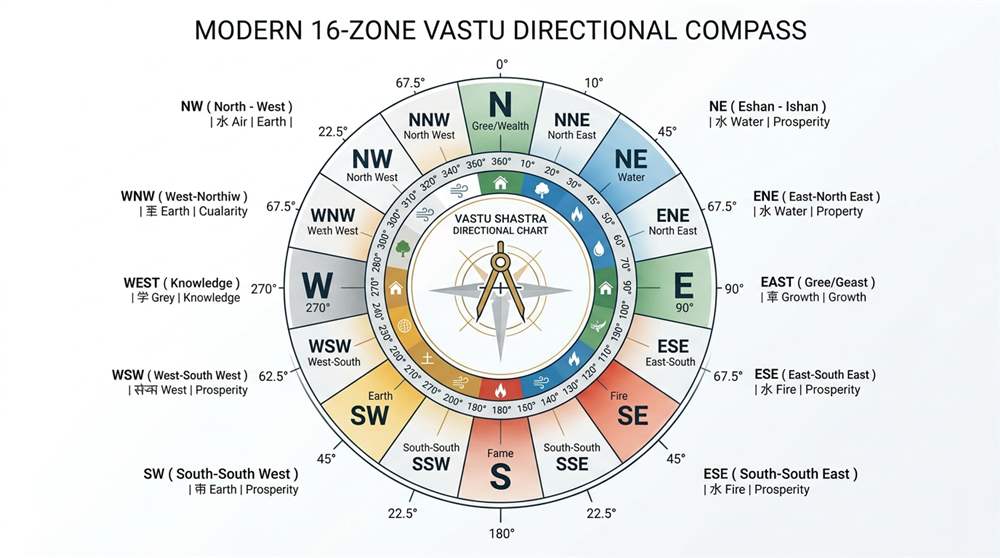
A Vastu direction chart divides a 360-degree compass into 16 zones. Each zone covers 22.5 degrees. The chart includes four cardinal directions, four corner directions, and eight smaller intermediate directions.
Vastu Shastra is a traditional Indian approach to building design, layout, and space use. It connects buildings with direction, sunlight, wind, the five elements, and faith symbols. The Vastu Purusha Mandala places directions around a central Brahmasthan.
The popular eight-direction model uses four main points and four corners. The 16-direction model adds two smaller zones between each pair. Northeast becomes north-northeast and east-northeast.
This distinction matters. A broad chart may place a room in the east. A 16-zone chart may place it in east-northeast or east-southeast.
Meanings vary across Vastu schools. One expert may call NNE a health zone. Another may connect it with new opportunities. Treat these labels as meanings, not facts.
Our accredited Diploma in Vedic Astrology Course covers how the larger grid connects with astronomical planetary dashas and birth charts. The 16-direction chart then provides a more detailed compass overlay.
What are the 16 directions in Vastu?
The 16 directions are N, NNE, NE, ENE, E, ESE, SE, SSE, S, SSW, SW, WSW, W, WNW, NW, and NNW. Each centre line moves 22.5 degrees clockwise.
The table below uses standard compass bearings. North equals 0 or 360 degrees. East equals 90 degrees. South equals 180 degrees. West equals 270 degrees.
The eight main directions also connect with old guardians. Indra is linked with east. Agni is linked with southeast. Yama is linked with south. Varuna is linked with west. Vayu is linked with northwest. Kubera is linked with north. Ishana is linked with northeast. Nirriti is linked with southwest.
These links belong to faith and local tradition. They do not predict income, illness, marriage, or exam results.
Why do some charts use eight directions and others use sixteen?
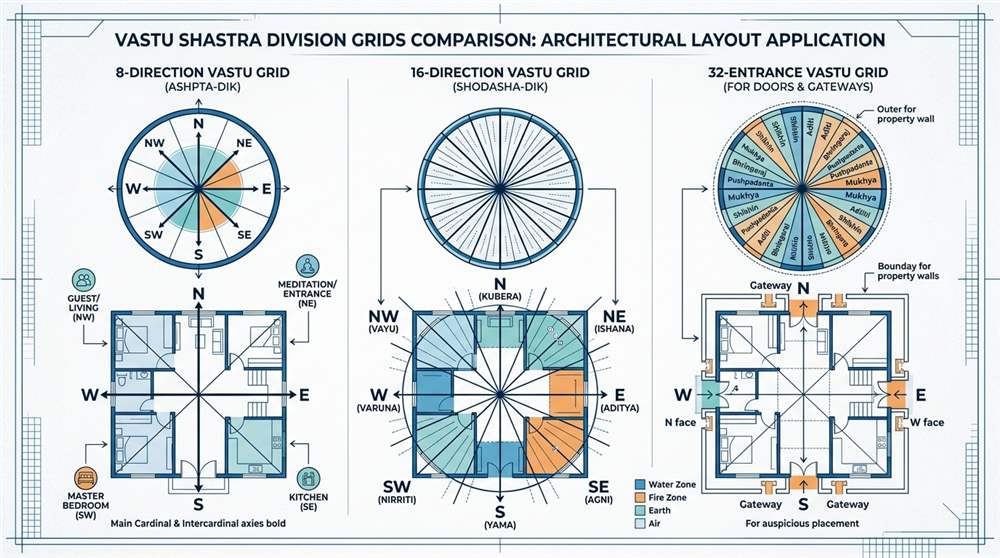
The eight-direction chart suits a quick layout check. The 16-direction chart gives more detail. Neither replaces a proper building review, safety check, or climate study.
An eight-direction model divides the compass into eight sections of 45 degrees. It suits a beginner who needs a broad layout.
A 16-direction model divides the compass into 16 sections of 22.5 degrees. It gives a narrower zone for a door, room, desk, or plot edge. That can help a careful expert, but it can create false exactness.
The 32-entrance system is different. It divides the compass into 32 sections of 11.25 degrees. Many pages blend it with the 16-direction chart. That confuses readers and encourages overconfident entrance claims.
Here is the practical comparison.
The 64-pada Manduka grid and 81-pada Paramasayika grid belong to the Vastu Purusha Mandala tradition. A building design resource links the 81-pada version with dwellings and the 64-pada version with temples. Schools can differ.
If someone calls a door “bad” at two degrees outside a zone, ask for the method and north reference. Precision should reduce confusion, not create fear.
What does each part of the Vastu direction chart mean?
The chart is most useful when you connect each zone with a suitable activity. Use it to organise light, heat, weight, movement, and privacy. Do not use it as a promise of wealth.
North to east-northeast
North is linked with Kubera, opportunity, and financial movement. It can suit an entrance, office work, or light storage. Keep it usable and bright.
NNE sits between north and northeast. Practitioners connect it with health or new possibilities. It can suit a reading chair or study corner. Do not turn this belief into medical advice.
NE, or Ishanya, carries sacred meaning. It often suits a pooja room, meditation area, or open garden corner. A lighter northeast side can receive morning light in much of India.
ENE sits between northeast and east. It often supports play, learning, and social openness. A reading nook can work here if the light stays cool.
East to south-southeast
East connects with sunrise, vitality, connection, and growth. East windows can bring morning daylight. Road access, privacy, heat, and security still matter.
ESE is commonly linked with analysis and planning. A desk can work here if glare stays under control. Add shade and airflow before symbolic objects.
SE, or Agni, is the fire corner. Vastu plans often place the kitchen here. A kitchen also needs heat removal, safe circuits, and airflow.
SSE is often linked with power and activity. It may suit equipment or a workout corner. Check temperature first.
South to west-southwest
South is often described as strength, discipline, and reputation. Many people fear it. That is too simple. Shading, layout, security, and climate can make it work.
SSW is often linked with disposal and release. It can suit a bathroom, utility space, or service zone. Plumbing and moisture control matter more than a symbolic cure.
SW, or Nairutya, is linked with weight, stability, and protection. It often suits a master bedroom, heavy furniture, or storage. Protect west-facing walls from afternoon heat.
WSW is linked with education and memory. It can suit a study or home office. Place the desk away from glare.
West to north-northwest
West connects with Varuna, gains, and endings. A west-facing room can become hot. Use shade, curtains, or trees. Do not blame Vastu for solar heat.
WNW often means movement and release. It can suit a guest room or laundry space. Cross-ventilation helps.
NW, or Vayavya, is linked with air, movement, support, and flow. It may suit a guest room or seating area. Avoid blocking windows.
NNW is often linked with attraction and social exchange. A dining corner or visitor room can fit this meaning. Keep movement clear.
How do you measure the 16 directions on a floor plan?
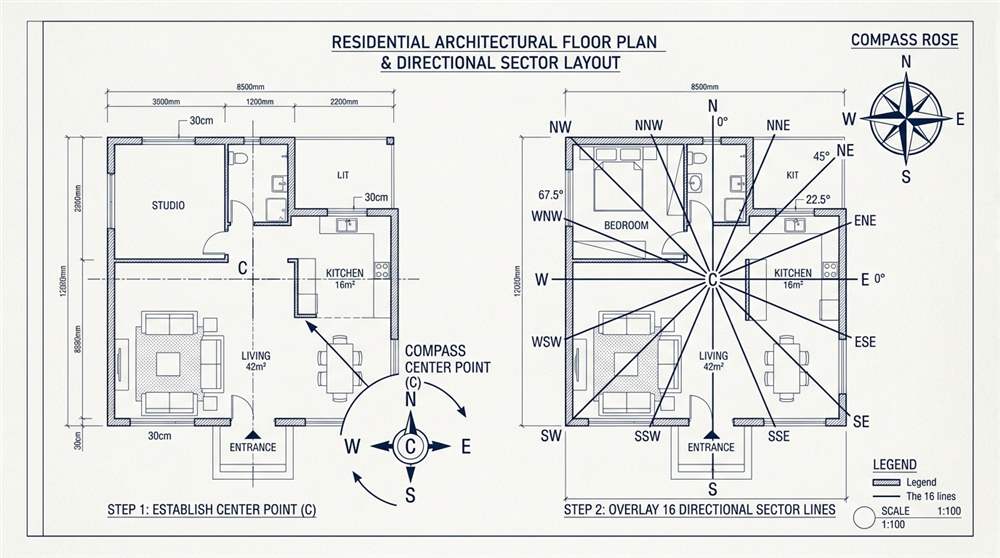
Find the centre, set north, record several readings, and overlay 16 sectors from the same point. Check first. Read second.
Use this process for a house or apartment.
- Obtain the most accurate floor plan available. Include extensions.
- Mark the geometric centre. Do not use the living room centre automatically.
- Stand away from steel, cars, appliances, electrical panels, and speakers.
- Take three to five readings. Wait for the needle to settle.
- Record the bearing in degrees. “91 degrees” is more useful than “roughly east.”
- Repeat the reading elsewhere. Investigate differences greater than three degrees.
- Mark north on the plan. Draw 16 centre lines at 22.5-degree intervals.
- Label each sector. Identify doors, toilets, kitchens, beds, stairs, tanks, and heavy storage.
- Compare the map with daylight, heat, ventilation, privacy, and structure.
Phone compasses are convenient, but reinforced concrete and metal furniture can disturb readings. Google Earth can verify the site axis, but not an interior door.
Magnetic north and true north also differ. A compass usually shows magnetic north. Surveyors may use true north. For boundaries or major building work, use a trained surveyor.
Which rooms suit which directions?
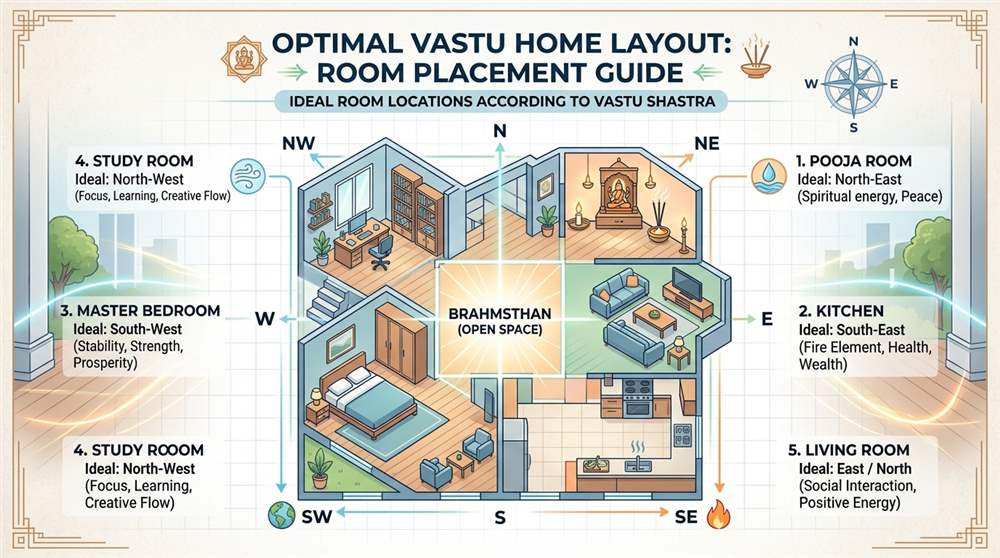
Room position should balance Vastu with function. Kitchens need safe heat removal. Bedrooms need quiet, steady temperatures, and rest. Bathrooms need good drainage and moisture control.
These are choices, not legal rules. Small flats combine rooms, and rentals have fixed plumbing. Access must come first.
Can the 16 directions work in apartments and rented homes?
Yes, but use the chart as a priority tool. You may not move walls, pipes, or the entrance. Focus on light, clutter, furniture weight, airflow, and safe use.
Illustrative Case Study 1: Small Apartment
Consider a 700-square-foot flat in Pune. A tall unit blocks the northeast corner. The kitchen is southeast, and the main bedroom is southwest. The sensible response is not rebuilding. Lower the storage, improve daylight, keep the centre open, and move rare-use items southwest. Morning light can then reach farther into the flat.
Illustrative Case Study 2: Hot West-Facing Room
Consider a west-facing office in Karachi. The owner blames the direction for poor concentration. A check finds a hot wall, afternoon glare, and a noisy fan. External shade, a reflective blind, quieter airflow, and a better desk angle address the problem. A symbolic remedy cannot replace sun control.
Illustrative Case Study 3: Rented London Flat
Consider a rented London flat. The tenant cannot change the entrance or kitchen. They map directions, choose a desk near daylight, keep the bed away from the radiator, and clear the centre. This respects Vastu without pretending that a rental can become a new building.
These are examples, not measured client outcomes. I would rather state that plainly than invent a salary increase after moving a plant.
What does Vastu say that building science can also explain?
Some Vastu advice has a sound climate or comfort reason. Other claims remain symbolic or faith-based. Keep those groups separate.
The northeast choice for openness can work in parts of India because it receives morning light. A real courtyard can support daylight and cross-flow. A southeast kitchen can support heat removal. A heavier southwest side can shade the west side.
The “Three-Test Rule” for Vastu Remedies
Keep Vastu advice only if it passes all three tests:
- Test 1: It respects safety and building rules.
- Test 2: It improves function, comfort, or cultural meaning.
- Test 3: It does not demand an expensive change without evidence.
If a remedy fails all three tests, save your money. Put it toward insulation, drainage, lighting, or a trained inspection.
What mistakes do people make with a Vastu direction chart?
Most mistakes come from wrong readings, fear, or confusing a symbolic guide with a building rule.
- Measuring from the wrong point: People stand at the front door and use that reading for the whole property. Use a consistent centre point.
- Confusing facing direction with road direction: A plot may face an east road while the entrance opens at another angle. Record both facts.
- Treating south or west as always bad: Heat, shade, window size, and climate matter. South light may help in a cold climate. West glass may need shade in a hot climate.
- Buying objects before fixing the layout: Decorative items cannot repair unsafe wiring or damp walls.
- Using one online chart as final authority: Compare the source, school, and method.
- Asking Vastu to answer a medical or money question: A room cannot diagnose illness. A direction cannot promise a promotion. Use trained experts for high-stakes decisions.
Need Personalized Vastu & Floor Plan Guidance?
Explore our professional consultation services or reach out directly to our master consultants.
Frequently asked questions about the 16 directions in Vastu
They are the four cardinal, four corner, and eight intermediate compass zones. Each centre line sits 22.5 degrees apart. The system starts at north and moves clockwise.
There is no best direction for every home. Choose one that suits climate, roads, daylight, airflow, privacy, safety, and your culture.
Not always. The entrance position and full layout matter. Climate matters too. Shade and airflow can make a south-facing home cool.
Vastu often values northeast for openness, prayer, and clarity. A toilet, damp wall, or blocked window still needs care. Northeast does not guarantee success.
Southeast is a common Vastu choice because it means Agni. Place the kitchen where airflow, fire safety, pipes, and safe movement work well.
Southwest, south, and west are common choices. Choose the room with steady temperature, privacy, and low noise. Sleep matters more than a label.
Take several readings away from interference. If they differ by more than three degrees, check metal, wiring, or devices before reading the chart.
For a home check, record which north your compass uses. For building, boundary work, or disputes, ask a surveyor to set the reference.
Furniture, lighting, cleaning, and use changes cost little. They cannot fix movement, dangerous wiring, serious damp, or poor drainage. Use the right expert.
The cultural and building tradition is real. Claims that a direction causes wealth, disease, or relationship outcomes lack strong proof. Separate climate gains from faith.
No. The 16-zone chart and 32-entrance system are different levels of division. Confirm which system a consultant uses.
Yes, as a choice framework. Focus on movable furniture, clutter, daylight, airflow, and safe use. Do not make costly building changes without approval.